Man’s Search for Meaning: Key Ideas
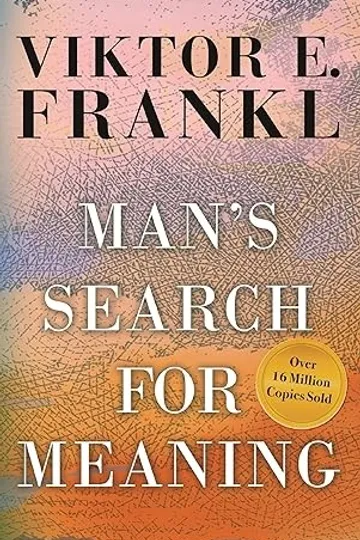
Viktor E. Frankl wrote Man’s Search for Meaning shortly after surviving the Nazi camps, and published it in German in 1946. These 26 cards follow the book’s two halves: what he observed about how prisoners endured or broke, and logotherapy — his psychotherapy built on the will to meaning, the three sources of meaning and the freedom to choose one’s attitude.
Practice this set for free — no account needed. Loads 26 flashcards into the learner.
Practice in the free learnerHow to study this set
Anchor the deck on two lists — the three phases of camp life and the three ways to find meaning. Every other card connects to one of them.

All 26 flashcards
What is the central claim of Man’s Search for Meaning?
The search for meaning is the deepest human drive; with a reason to live, people can endure almost any suffering.
What are the two parts of the book?
An account of Frankl’s experiences in the concentration camps, and an introduction to logotherapy.
Later editions add a postscript, “The Case for a Tragic Optimism”.
What did Frankl live through before writing the book?
Imprisonment in four Nazi camps, including Auschwitz; the Holocaust took his wife, parents and brother.
How quickly did Frankl write the book?
In nine days, dictated in Vienna soon after the war.
What are the three phases of a prisoner’s mental reaction?
Shock on admission, apathy during camp life, and bitterness and disillusionment after liberation.
What is the “delusion of reprieve”?
The false hope of new arrivals, like a condemned man’s, that they would be spared at the last moment.
What does Frankl call the last of the human freedoms?
The freedom to choose your attitude in any circumstances — the one thing no one can take away.
Which idea of Nietzsche’s does Frankl return to?
That someone who has a why to live for can bear almost any how.
What sustained Frankl on forced marches in the camps?
Thinking of his wife and holding imagined conversations with her.
It convinced him that love is the highest goal a person can aspire to.
Why did some sensitive prisoners endure camp life better than robust ones?
A rich inner life let them retreat from the horror around them into inner freedom.
What happened to prisoners who lost faith in the future?
They often gave up and died soon after.
Frankl reports a spike in deaths after Christmas 1944, when hopes of being home by then collapsed.
What role did humor play in the camps, according to Frankl?
It was a weapon of the soul that let prisoners rise above their situation, if only for moments.
What did Frankl conclude about guards and prisoners?
There are only two kinds of people — the decent and the indecent — and both are found in every group.
What personal goal helped Frankl survive?
Rewriting the manuscript on his theory that had been taken from him on arrival at Auschwitz.
What is logotherapy?
Frankl’s school of psychotherapy, which helps people find meaning in their lives.
From the Greek logos, “meaning”; it is called the Third Viennese School of Psychotherapy.
How does logotherapy differ from Freud and Adler?
Freud stressed the will to pleasure and Adler the will to power; Frankl puts the will to meaning first.
What are the three ways to discover meaning, according to Frankl?
Creating a work or doing a deed; experiencing something or loving someone; the attitude you take toward unavoidable suffering.
Is suffering necessary to find meaning?
No — avoidable suffering should be avoided; meaning lies in how we face the suffering we cannot avoid.
How does Frankl turn the question of life’s meaning around?
Stop asking what we expect from life, and ask what life expects from us.
Why is there no single meaning of life, for Frankl?
Meaning differs from person to person and from moment to moment.
What is the existential vacuum?
A widespread sense of emptiness and meaninglessness, often showing itself as boredom.
His “Sunday neurosis” is the low mood some feel when the busy week ends.
What is paradoxical intention?
A logotherapy technique in which patients deliberately wish for what they fear, which weakens the fear.
What is dereflection?
Turning attention away from yourself and your symptoms toward something or someone else.
What is the tragic triad?
Pain, guilt and death — the parts of life no one escapes.
Tragic optimism means saying yes to life in spite of them.
Why can’t happiness be pursued directly, according to Frankl?
It must follow as a side effect of dedication to a cause or to another person.
Why did Frankl propose a Statue of Responsibility?
To balance the Statue of Liberty: freedom without responsibility turns into arbitrariness.
He suggested placing it on the US West Coast.